

Mathematics is often presented as a world of abstract ideas, symbols and procedures. But it is also a human endeavour, full of imagination, discovery, conflict, creativity and meaning.
My work explores how storytelling can transform the ways we teach, learn, communicate and experience mathematics.
Stories have always helped people make sense of the world. They connect ideas with experiences, invite curiosity and give meaning to events.
My research investigates what happens when we bring these possibilities into mathematics education. Can storytelling help students see mathematics differently? Can creating stories encourage deeper engagement with mathematical ideas? And what new possibilities emerge when mathematics becomes an essential part of a narrative, rather than simply something mentioned within it?
These questions have guided a programme of teaching innovation and research that has grown from my own university classroom into an international initiative.
Mathstory invites students to create short digital stories in which mathematics plays a meaningful role. Rather than simply presenting a mathematical explanation, students are challenged to imagine, construct and communicate a story where mathematical ideas matter.
What began as an approach to teaching university mathematics has developed into an international competition, bringing together students and educators across countries and educational contexts.
The best way to understand Mathstory is to experience one. These short films show how students have used imagination, mathematical ideas and storytelling to communicate mathematics in unexpected ways.
A “Romeo and Juliet” archetype used to explain addition of fractions with different denominators. Created by Jarrah Marsh and Zachary Hicks.
Deepa Selva explains game theory’s “prisoner’s dilemma”, a model used to explain how people decide whether to cooperate or not. This was the 2021 Mathstory first prize winner.
The ‘Math Fairy” explains how mathematics can be used to decorate while moving home. Lawrence Falk, Jazleen Virdi, and Jenah Graham created the 2025 Mathstory first-prize-winning video.
Mathstory is part of a wider programme of research into narrative approaches to mathematics education.
My work examines the relationships between storytelling, mathematical thinking, imagination and participation. I am particularly interested in how narratives can create opportunities for students to engage with mathematical ideas, communicate their understanding and experience mathematics as a meaningful human activity.
This research brings together theoretical perspectives, educational design and clasroom investigations, with the aim of developing approaches that are both intellectually rigorous and useful to educators.
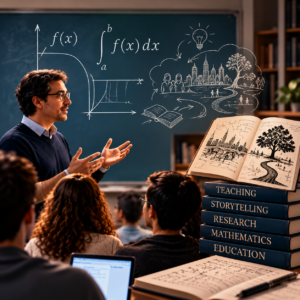
This project is a collaboration with Dr. Eirini Kouvela at the Institute of Applied Sciences Wiener Neustadt. We are looking into why (or why not) lecturers use of narrative in their teaching of university mathematics.
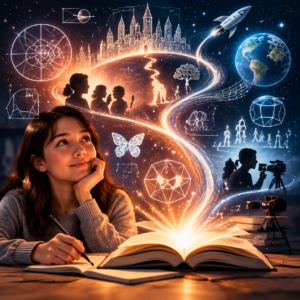
This research investigates how creating mathematical stories can open different ways for students to engage with mathematics, communicate their ideas and see the relevance of the subject to our societies.

This research explores the possibilities of narrative for connecting mathematical models with human experiences and real-world situations.
My work on narrative pedagogy has developed through an ongoing dialogue between educational theory, classroom experimentation and research. Teaching innovations provide opportunities to investigate new ideas, while research findings inform subsequent developments in teaching and assessment.
Recent publications relating to my research on narrative and storytelling in mathematics education:
Hernandez-Martinez, P. (2026). Telling stories about Mathematics and its relevance: The vision behind the International Mathstory competition. In A. Rogerson & J. Morska (Eds.) Envisioning the Future of Mathematics Education: Innovations, Strategies and Challenges in the AI Era (pp.61-66). Munster: WTM. https://doi.org/10.25916/sut.31856407
Hernandez-Martinez, P. & Keane T. (2025). Learning Mathematics and its Relevance through a Digital Storytelling Assessment Task at University. International Journal of Mathematical Education in Science and Technology, 56(5), 811-827. https://doi.org/10.1080/0020739X.2023.2295895
There is still much to understand about the relationship between narrative, imagination and mathematical learning.
My current work is extending this research through new theoretical developments, collaborations across educational contexts and investigations into how students create and experience mathematical stories.
An important ambition is to build a stronger research foundation for narrative approaches to mathematics education, while developing practical resources that help educators bring these ideas into their own teaching.
Whether you are a teacher interested in using storytelling, a student with a story to tell, or a researcher exploring new approaches to mathematical learning, I would welcome the opportunity to connect.
(Details in the footer)